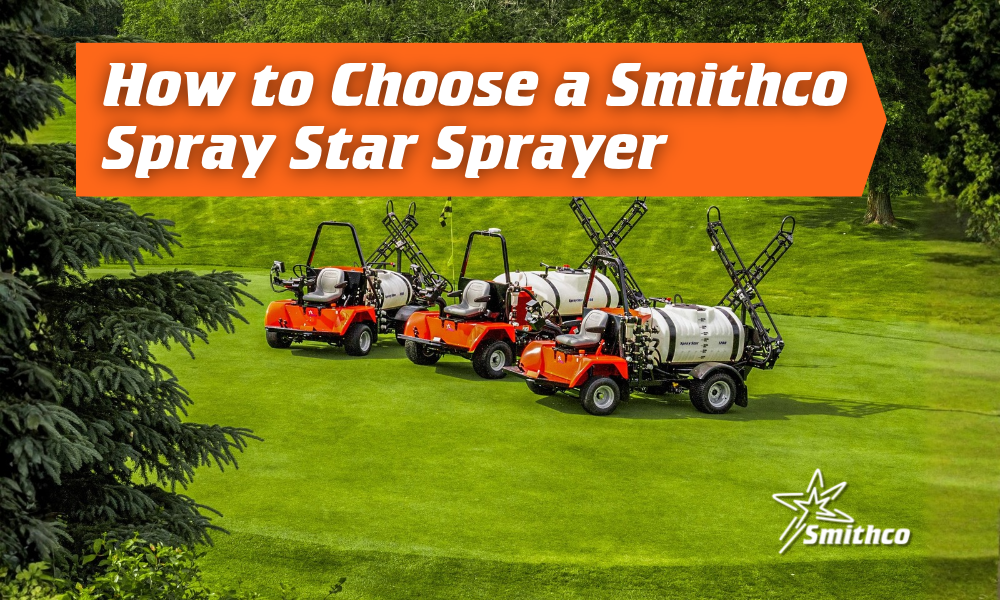
How to Choose a Smithco Spray Star Sprayer
What your next machine needs to do for your course, your crew, and your budget.
Most golf courses already have a few sprayers in the rotation. There’s one that handles fairways, one that spends more time on greens and tees, and often an older machine that still gets called into service for rough applications.
So when it’s time to buy another, you’re not starting from scratch. You’re deciding what the next sprayer needs to take over, what stays in service, and where a better machine could pay you back.
Maybe it’s replacing a tired greens sprayer. Maybe it’s giving fairway work its own machine. Or maybe chemical costs have reached the point where GPS control deserves a much closer look.
Smithco offers three Spray Star sizes, with a gasoline and diesel choice in the 200-gallon class. Here’s how I’d sort through them.
Start With the Fleet You Already Have
You know which sprayer your operator prefers on greens and which one gets sent out when fairways are on the schedule. What would help most: a more maneuverable machine, a flexible unit that can take on several jobs, or better control over expensive applications?
Look at your actual routes, boom clearance, ground conditions, and spray program. Tank size matters, but only after you’ve decided what work the machine needs to own.
Three Spray Star Sizes. Different Strengths.
Spray Star 1110 | 110 gallons
Smithco’s lightest, most maneuverable self-contained spray vehicle is a natural fit for greens, tees, and smaller treatment areas. The 1110 pairs a 110-gallon tank with a 23-hp Vanguard gasoline engine.
And compact doesn’t mean limited to basic controls. The 1110 can be equipped with Star Command II and GPS-based individual nozzle control. If the work calls for a smaller machine, you don’t have to give up precision to get it.
Spray Star 1200 / 1200D | 200 gallons
The 200-gallon class is the versatile option. A 1200 can serve as a dedicated sprayer or move between fairways, approaches, greens, and tees, depending on your course and spray schedule.
The gasoline 1200 uses a 35-hp Vanguard engine; the 1200D uses a 24.8-hp Kubota diesel. The better choice depends on your fleet, fuel setup, and service preferences. If your next machine needs to cover several roles, the 1200 deserves a look.
Spray Star 1300 | 300 gallons
For dedicated fairway work and larger treatment areas, the 1300 offers a 300-gallon tank, a 57-hp Kubota gasoline engine, and available boom configurations up to 20 feet.
This is where capacity and boom width can work in your favor on larger applications. Just make sure the machine’s dimensions, loaded weight, and boom configuration fit your property. The right fairway sprayer has to get around the course as well as it sprays it.
The Spray Controls Deserve Their Own Conversation
Tank size is easy to compare. Spray controls deserve just as much attention because they affect how accurately you apply the product you’re already paying for.
TeeJet 744A | Straightforward Boom and Pressure Control
The 744A gives the operator electric pressure adjustment and on/off control of boom sections from the seat.
It’s a straightforward option for crews that prefer direct control without the added cost and complexity of automatic rate control or GPS.
The tradeoff is that it doesn’t automatically adjust the application rate when ground speed changes. The operator still manages speed and pressure to maintain the intended rate.
TeeJet Radion 8140 | Automatic Rate Control
Set a target application rate and the Radion 8140 uses speed and flow information to adjust output as the sprayer speeds up or slows down.
It also displays useful application data, including rate, pressure, speed, volume applied, and area covered.
For a superintendent who wants automatic rate control without full GPS coverage mapping and nozzle-by-nozzle shutoff, the 8140 is a practical middle ground.
Changes in flow can affect pressure and droplet size, so nozzle selection and calibration still matter.
Star Command II | AgLeader InCommand GPS-based Precision
Star Command II combines GPS-based coverage management with Ag Leader’s RightSpot pulse width modulation technology.
Individual nozzles can shut off over previously treated turf and turn back on over untreated ground. Turn compensation adjusts output through curves, and the system can manage flow while holding a selected pressure within its operating range.
Mapping and reporting help document completed work.
Picture an irregular fairway edge or a pass around a bunker. One part of a conventional boom section may be over untreated turf while another part crosses ground you’ve already sprayed.
Controlling individual nozzles helps limit that overlap.
It’s the option I’d look at hardest for a machine handling frequent, complex, or high-cost applications.
The distinction is simple: the 744A lets the operator manage pressure and sections, the 8140 automatically manages application rate, and Star Command II adds GPS-based coverage control at the nozzle level.
Each is a different level of investment, and each has a place in the right spray program.
What Can GPS Spraying Actually Save?
The USGA has reported that GPS-guided spraying can reduce product use by 10–20% in most cases through more accurate application.
That’s not a Smithco-specific test result or a guaranteed return, but it is a useful industry benchmark.
On a hypothetical $60,000 annual spray-product program, a 10% reduction across that same program would avoid $6,000 in product cost; at 20%, it would be $12,000.
Your opportunity depends on which applications can benefit from GPS, your current overlap, and the products you use.
That’s why I’d take a hard look at GPS on the machine handling your most frequent or most expensive applications.
Not because every sprayer needs the highest-level controller, but because that’s where the technology has a chance to justify its cost.
The Details Still Matter
A wider boom can reduce passes on open fairways, while a smaller setup may be easier around trees, bunkers, and narrow approaches.
Smithco offers different boom and control combinations by model, so make sure the full configuration fits the job.
Chemical loading systems, water fill meters, hose reels, spray guns, and rinse equipment deserve a look, too. These are the things your operator uses before and after the application, and they can make the daily routine easier.
Ask about training, service access, local parts support, and any applicable correction-service or software costs.
The purchase price is important, but so is what it takes to operate and maintain the machine.
Put the Right Sprayer Into the Rotation
Bring your current spray fleet, application program, and chemical spend to the conversation with your Smithco dealer.
Show us what each machine does today and where you’d like the next one to improve the operation. Better yet, get your operator involved in a demonstration.
Maybe it’s an 1110 for greens and tees, a 1200 that handles several jobs, or a 1300 with Star Command II dedicated to fairways.
Whatever the answer, the equipment and the cost should make sense together.
That’s the conversation we’re here to have.
Explore the Smithco Spray Star lineup and work with your local dealer to build a sprayer around the work you actually do.