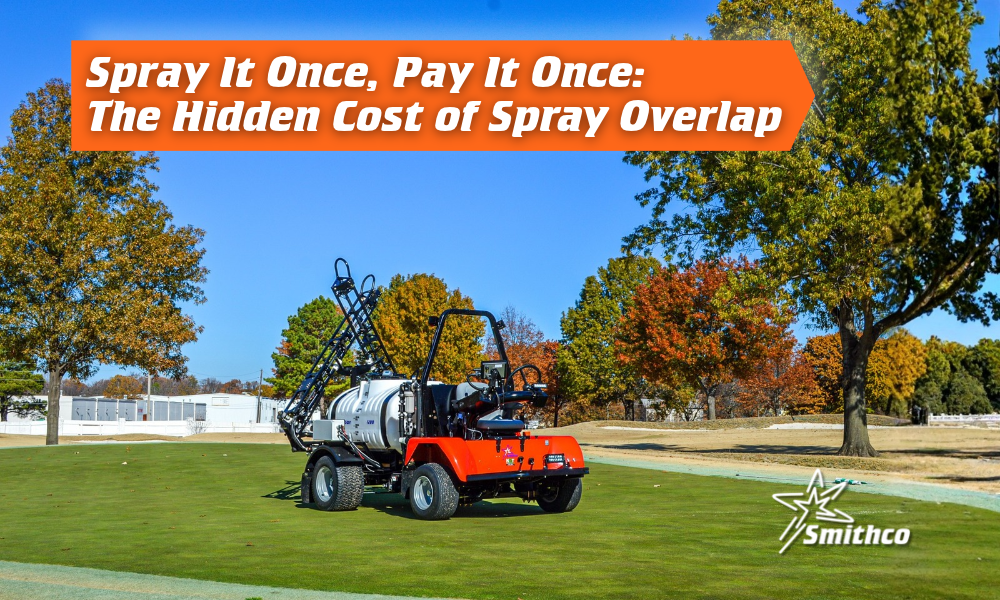
Spray It Once, Pay It Once: The Hidden Cost of Spray Overlap and Why GPS Spraying Is Worth a Closer Look
Nobody wakes up in the morning planning to spray the same turf twice. But it happens.
A little extra coverage along a fairway edge. A wide turn around a bunker. A boom section that stays on just a few seconds longer than it should.
No big deal, right?
Well, maybe not once. But multiply those little overlaps across 18 holes, several applications, and an entire growing season. Suddenly, you’re spending good money putting product somewhere you’ve already put it.
And considering what we’re paying for turf chemicals these days, that’s worth talking about.
Here’s the interesting part. Golf course superintendents who have made the move from conventional spraying to GPS-guided precision application have reported product savings in the neighborhood of 10–20%.
That’s a pretty substantial number, especially when you consider that we’re not talking about reducing your intended application rates or changing your agronomic program.
We’re talking about being more efficient with the products you’re already buying.
Golf Courses Aren’t Square. That’s Part of the Problem.
If every fairway were a perfectly straight rectangle, spraying would be pretty simple. Set your rate, line up your passes, and off you go.
Unfortunately, golf course architects didn’t have spray efficiency at the top of their priority list.
We’ve got doglegs, bunkers, narrow approaches, irregular fairway edges, and plenty of other things that make maintaining consistent coverage a challenge.
Even a great operator has a lot going on. They’re watching their speed, managing the boom, navigating obstacles, and trying to maintain accurate coverage.
And when there’s any doubt, most operators would rather overlap a little than leave a strip untreated.
That makes sense. Nobody wants to finish a PGR application only to find an untreated stripe running down the middle of a fairway.
But there’s a cost to that extra coverage…
Think about spraying a fairway with a conventional boom-section system. As you work around a bunker or an irregular edge, part of that section may be covering untreated turf while the rest is passing over ground you’ve already sprayed.
You can leave the section on and overlap, or shut it off and risk missing something.
Neither is particularly appealing.
Now repeat that situation dozens of times across the property.
It’s not hard to understand where the waste comes from.
Let’s Talk About That 10–20%.
This isn’t a number somebody dreamed up in a sales meeting.
In 2019, James Beebe, then golf course manager at Priddis Greens Golf & Country Club, shared his experience with GPS spraying in GreenMaster, the Canadian Golf Superintendents Association’s publication.
After three years using GPS spray technology, his operation reported product savings of 10–20% across applications to greens, tees, fairways, and rough.
The USGA has documented similar experiences.
At Hidden Creek Golf Club in New Jersey, superintendent Clark Weld reported annual spraying costs running approximately 15–20% lower after implementing GPS-guided spraying.
Different courses, different equipment, and different spray programs. But both demonstrate that meaningful savings are achievable when unnecessary application is reduced.
So what does that look like in dollars?
Let’s say your course spends $80,000 annually on products applied through a conventional spray program.
A 10% reduction in product use, assuming the same products and application rates, represents $8,000 in annual savings.
At 15%, you’re looking at $12,000.
And at 20%? That’s $16,000.
That’s real money.
Now, those are illustrative calculations, not a promise that every course will achieve those results. Your actual savings depend on your current application efficiency, the areas you’re treating, and the technology you’re moving from.
A course that’s already doing an exceptional job limiting overlap may have less room for improvement than one with complicated spray routes and conventional boom-section controls.
But that’s exactly why the conversation is worth having.
Even at the lower end of those documented results, the financial impact can be significant.
And those dollars don’t necessarily have to disappear from your budget. They might be better spent on another fungicide application, additional fertility, equipment maintenance, or any number of things you’ve been trying to find room for.
I don’t know many superintendents who couldn’t find a productive use for another $8,000.
The Chemical Isn’t the Only Thing You’re Paying For.
Let’s take this a little further.
Every unnecessary gallon of spray solution has to come from somewhere.
Somebody measured the product. Somebody mixed it. Somebody filled the sprayer.
And if overlap means you’re using more solution than necessary, there’s a chance you’re making another trip back to the maintenance facility before the job is finished.
More mixing. More filling. More time.
If reducing unnecessary application allows you to eliminate a refill, that’s time back in your day.
And anybody who’s tried to finish a fairway spray ahead of morning play knows just how valuable that time can be.
Now, I’m not suggesting GPS is going to magically eliminate half your labor expense.
But there’s a difference between saving payroll dollars and making better use of the people you’ve already got.
If your spray technician finishes an application earlier, maybe they can help with morning setup. Maybe they can get started on another maintenance project. Maybe you simply have a little more breathing room before the first groups make the turn.
There’s always another job waiting.
Anything that helps your crew accomplish more in the same amount of time deserves some consideration.
Your Turf Doesn’t Appreciate the Extra Attention, Either.
The financial argument is compelling, but I think there’s another piece of this that’s just as important.
Application consistency.
When you make a fungicide application, apply fertilizer, or put down a plant growth regulator, you’ve selected a particular rate for a reason.
You want the product where it belongs, at the rate you’ve determined is appropriate.
Overlapping passes can result in portions of the turf receiving more product than intended.
Depending on the chemistry and growing conditions, that can mean inconsistent growth regulation, discoloration, or even turf injury.
Think about a PGR application on greens.
The intended treatment is on the putting surface, but unnecessary overlap onto the collar can expose that turf to additional growth regulation. Under the wrong conditions, that can contribute to problems nobody wants to deal with.
The same principle applies when navigating fairway edges, approaches, and transitions between maintained areas.
On the other side of the equation, shutting off a boom too early can leave untreated strips.
Neither outcome helps you maintain consistent playing conditions.
And that’s really what precision spraying is about.
Not applying less product simply for the sake of applying less product. It’s about delivering the intended rate to the intended area, without wasting product where it doesn’t belong.
So, What Does GPS Actually Do for You?
Here’s where the technology starts earning its keep.
We’ve all heard the term precision spraying. But I think it’s worth explaining what that actually means when you’re sitting in the operator’s seat.
Smithco’s Star Command II combines GPS-based application control with Ag Leader’s RightSpot™ technology.
And while there are plenty of features worth discussing, three are particularly important when we’re talking about application efficiency.
Individual Nozzle Control: Stop Spraying What You’ve Already Sprayed.
Remember that fairway with the awkward bunker and irregular edges?
This is where individual nozzle control makes a difference.
Rather than relying on the operator to switch entire boom sections on and off, the system uses GPS coverage information to automatically control solenoids found at individual nozzles.
As a nozzle enters an area that’s already been treated, it can shut off instantly. When it reaches untreated ground, it turns back on.
That means fewer unnecessary overlaps and less product wasted outside the intended treatment area.
It’s especially valuable around greens, tees, bunkers, and approaches, where the geometry rarely works in your favor.
And this is an important distinction when evaluating GPS spray systems.
GPS guidance alone isn’t the same as automatic individual nozzle control. It’s the combination of accurate positioning, coverage mapping, and nozzle-level shutoff that makes these savings possible.
The goal isn’t fewer acres receiving the treatment they need.
It’s fewer acres receiving that treatment twice.
Turn Compensation: Because the Outside of the Boom Has Further to Go.
Here’s something that’s easy to overlook.
When your sprayer makes a turn, be it slight or significant, the outside end of the boom travels farther and faster than the inside.
If every nozzle delivers the same amount of product, the inside of the turn can receive too much per acre while the outside receives too little.
RightSpot’s turn compensation adjusts individual nozzle output to account for those differences.
The result is better application-rate consistency across the boom as you navigate turns.
And considering how rarely we get to spray in perfectly straight lines on a golf course, that’s a pretty useful feature.
This is about application quality as much as chemical savings.
You’re working to deliver the same intended treatment across the entire width of the boom, even when your travel path isn’t perfectly straight.
Pulse Width Modulation: Speed Changes Without Chasing Pressure.
We’ve all been there.
You’re moving comfortably down a fairway, then you hit the big hill or have to slow down to navigate a bunker, a tree, or a tight approach.
Your sprayer needs to adjust its output to maintain the correct application rate.
On a conventional system, that often means changing spray pressure, which can also affect spray characteristics and droplet size.
Pulse width modulation, or PWM, approaches that differently.
By rapidly opening and closing solenoid controlled nozzles, the system adjusts the amount of liquid delivered without relying entirely on changes in pressure.
Ag Leader’s RightSpot system provides independent rate and pressure control, allowing operators to maintain a selected spray pressure while adjusting output across its operating range.
In plain English?
You have more flexibility to change speed while maintaining the intended application rate and spray characteristics.
That matters when you’re constantly adjusting your travel speed to accommodate the layout of a golf course.
And when you combine PWM with individual nozzle control and turn compensation, you’ve got a system that addresses several of the challenges operators face every time they head out to spray.
Don’t Take My Word for It. Look at Your Own Numbers.
Here’s what I’d encourage any superintendent to do before making a decision about GPS spray technology.
Take a good look at your current spray program.
How many acres are you treating? What products are you applying? How much should those applications cost based on your intended rates?
More importantly, how much product are you actually using?
Where are the difficult areas on your property? Are you constantly working around bunkers and irregular boundaries? Are your operators making extra passes to avoid skips? How often are you refilling?
Those are the kinds of questions that help establish whether precision spraying could make a meaningful difference in your operation.
And don’t assume every gallon beyond your calculated requirement is caused by overlap. Calibration, acreage estimates, leftover spray solution, and other factors can affect product usage.
You need a fair starting point.
Once you’ve established that baseline, you can begin evaluating what a reduction in unnecessary application might be worth.
Star Command II offers application mapping, data logging, and reporting capabilities that can help superintendents track product use and review completed applications.
That’s useful information whether you’re evaluating equipment, managing your chemical budget, or simply looking for opportunities to improve your operation.
And when you’re considering a new sprayer, those potential savings should be weighed against the complete investment, including equipment, training, service, and any applicable subscriptions.
A properly supported purchasing decision should be built around what the equipment can accomplish on your property.
The Bottom Line
Sometimes I think we get so caught up talking about technology that we forget what we’re actually trying to accomplish.
We’re not putting GPS on sprayers because having another screen in the cab is exciting.
We’re doing it because chemicals are expensive, labor is valuable, and superintendents have enough on their plates without paying to treat the same ground twice.
The 10–20% savings reported by golf course operations using GPS spraying are worth taking seriously.
They’re not a guarantee for every course, and they’re not results being attributed specifically to Smithco equipment. But they demonstrate that reducing unnecessary application can provide meaningful financial benefits.
And the opportunity extends beyond the chemical budget.
It’s more consistent application rates. Better control around sensitive areas. Less reliance on manual boom-section management. And potentially fewer unnecessary trips back to the shop.
None of this replaces a knowledgeable operator, proper calibration, good agronomic decisions, or following the product label.
It gives your team better tools to execute the spray program you’ve already developed.
At Smithco, that’s how we believe equipment should earn its place in your operation.
We’d rather sit down, look at what you’re spraying, understand where you’re spending your time and money, and determine whether the technology makes sense for your course.
Because at the end of the day, you’ve already invested in the chemicals, the sprayer, and the person operating it.
You might as well make every pass count.
Explore the Smithco Spray Star lineup and learn more about Star Command II at smithco.com.