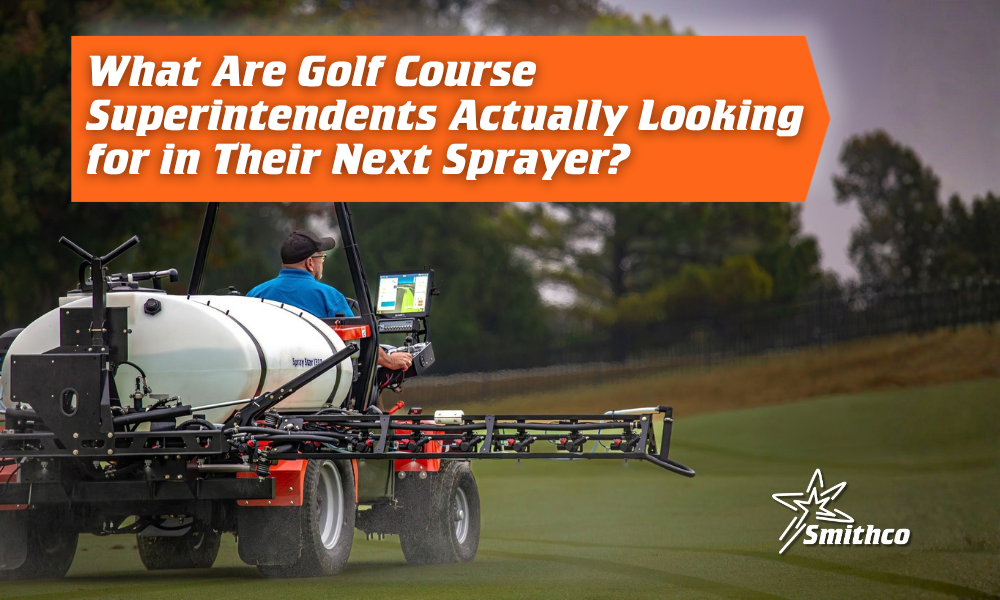
What Are Golf Course Superintendents Actually Looking for in Their Next Sprayer?
Ask ten golf course superintendents what matters most in a sprayer and you probably won’t get the same answer ten times.
One may immediately talk about application accuracy. Another wants something the entire crew can operate confidently. Someone else is thinking about boom visibility, downtime, parts availability, or whether the latest technology will actually save enough time and product to justify the investment.
That’s really the point.
In the conversations Smithco has with superintendents, operators, and dealers, choosing a golf course sprayer is rarely about finding the machine with the longest feature list. It’s about solving the everyday challenges that come with getting product out accurately, efficiently, and on time.
So, what are turf professionals actually asking about when they start looking for their next sprayer?
“How Accurate Can We Actually Get?”
Precision is almost always part of the conversation.
Superintendents are managing valuable inputs, tight application windows, and high expectations for playing conditions. Skips, overlap and inconsistent coverage can affect both the turf and the budget.
But accuracy isn’t just about hitting a target application rate once. What matters is being able to do it consistently across the course.
Can the sprayer compensate through turns? Can the operator maintain the desired pressure and droplet size? Can individual areas of the boom be controlled to help minimize unnecessary application? What happens when you’re spraying around greens, bunkers, approaches or irregular edges?
Those are the kinds of problems precision spray technology is intended to solve.
For example, Smithco’s Star Command II 4.0, powered by Ag Leader, combines GPS guidance with RightSpot™ pulse width modulation, individual nozzle control, and turn compensation. Instead of simply adding technology to the machine, those tools are designed to give operators greater control over how and where material is applied.
Because at the end of the day, “precision” only matters if it creates a more consistent application in the field.
“Can My Crew Actually Use It?”
Spraying technology has advanced quickly. That’s a good thing, until a system becomes so complicated that only one person on the crew feels comfortable operating it.
That concern comes up more than you might think.
Superintendents are managing teams with different experience levels, responsibilities, and comfort with technology. If the spraying program depends entirely on one highly trained operator, scheduling becomes harder and an absence can quickly turn into a problem.
So ease of use matters.
Operators want to be able to understand what the machine is doing, make adjustments without digging through endless menus, and get comfortable with the system without weeks of training.
Smithco’s Star Command II 4.0 brings GPS guidance, mapping, and individual nozzle control into the spraying process. When evaluating those capabilities, consider how your operators will use them day to day, and what training and support will help the whole crew feel comfortable behind the wheel.
More technology isn’t automatically better. The right system gives your crew useful capabilities they can confidently put to work.
“Can I See What I’m Doing?”
For all the conversation around software, GPS, and automation, sometimes one of the most important turf sprayer features is much simpler:
Visibility.
Operators need to know where the boom is, where the nozzles are applying, and how the machine is positioned relative to the turf around them.
Good visibility can make it easier to work around bunkers, greens, trees, cart paths, and other obstacles. It can also make the operator feel more connected to the machine instead of relying entirely on what a screen is telling them.
That kind of feedback has influenced the design of Smithco’s Spray Star equipment. Models like the Spray Star 1300 use a cab-forward configuration designed to provide better visibility from the operator’s position.
It isn’t the flashiest feature on a specification sheet.
But when you spend hours in the seat, it matters.
“Is This Technology Actually Going to Save Us Anything?”
This may be one of the biggest questions in choosing a golf course sprayer today.
Technology can do impressive things. But superintendents still have budgets to manage.
So the conversation eventually comes back to return on investment.
Will this system help reduce overlap?
Can it help us use product more efficiently?
Could it allow additional members of the crew to make applications confidently?
Will it save time during spraying?
Can it improve consistency enough to reduce mistakes or rework?
That’s where features such as GPS guidance, individual nozzle control, turn compensation, and PWM become more than technology for technology’s sake.
If a sprayer can help limit unnecessary application, improve operator consistency, or make spraying less dependent on one highly experienced employee, those benefits can add up over the life of the machine.
Technology has to earn its place on the sprayer. And increasingly, it also has to earn its price.
“What Information Do I Get After the Application?”
The job doesn’t necessarily end when the boom folds up.
Superintendents are paying more attention to the information that comes back from their turf spraying equipment.
Where was product applied?
How much was used?
Were there areas that were missed or treated twice?
Can application information be reviewed later?
Can those records help the superintendent better understand chemical use or document completed work?
Modern GPS-based spray systems can make spraying a more measurable process rather than something that lives entirely in the operator’s memory.
With systems such as Star Command II 4.0, mapping and application data become part of the spraying process. That gives turf managers another tool for reviewing completed work, keeping records, and making decisions about future applications.
For operations looking closely at input costs and accountability, that information can be nearly as valuable as the application itself.
“What Happens When Something Goes Wrong?”
Nobody buys a new sprayer because they’re excited about servicing it. But serviceability matters the moment something needs attention.
Golf course maintenance teams often operate within narrow windows dictated by weather, play schedules, tournaments, and turf conditions. If the sprayer is down when those windows open, the impact can be much bigger than a machine sitting in the shop.
That’s why superintendents and equipment managers ask practical questions:
Can routine maintenance be handled easily?
Are common service points accessible?
Can we get parts?
Who do we call when we need help?
Can a dealer or manufacturer help us troubleshoot an issue quickly?
That support matters increasingly as sprayers combine mechanical systems with more sophisticated spray controls and GPS technology.
Smithco’s extensive dealer network helps put that support within reach. Dealers receive training to build teams proficient in Smithco equipment and maintain parts inventory to support maintenance and repairs. That gives golf course crews a knowledgeable resource for troubleshooting, service, and replacement parts, helping them address issues and get back to work.
“What Size Sprayer Actually Fits Our Course?”
There’s no universal answer to what makes the “best” golf course sprayer because golf courses themselves aren’t universal. (Just as long as it’s orange and says Smithco on the side.)
A large property covering substantial acreage may prioritize capacity and productivity. Another course may care more about a light footprint or manueverability.
That’s why tank capacity, boom size, and overall machine configuration should be evaluated based on how the sprayer will actually be used.
Smithco’s Spray Star lineup reflects those different needs. For example, the Spray Star 1110 uses a 110-gallon tank on a lightweight, maneuverable platform, while the Spray Star 1200 offers a larger 200-gallon capacity for operations that need to cover more ground between fills. For courses with more acreage to maintain, the Spray Star 1300 steps up to a 300-gallon tank and boom options up to 24 feet, helping crews cover larger areas with fewer refill stops.
None are automatically the right answer.
The better question is:
Which one fits the way our course operates?
A sprayer should fit the acreage, terrain, crew, application frequency, and spraying program. Not the other way around.
“Will It Hold Up?”
After all the conversations about GPS, nozzles, controls, and data, there’s still one question that tends to cut through everything else:
Will the machine work when we need it?
Sprayers live busy lives.
They operate through long days, changing terrain, seasonal application schedules, and environments where a missed spraying window can have real consequences.
That makes reliability less of a “feature” and more of a baseline expectation.
Technology can help an operator be more precise. Better visibility can make a machine easier to use. Application data can provide valuable insight. But none of those things matter much if the equipment underneath them isn’t dependable.
For Smithco, that’s why the conversation about spraying has never been technology or equipment.
It has to be both.
So, What Should You Look for in a Golf Course Sprayer?
There isn’t one feature that determines whether a sprayer is right for your operation.
Based on the conversations we continue to have with superintendents, operators, and dealers, the decision usually comes down to a combination of questions:
Can we spray accurately and consistently?
Can more than one person on our crew operate it confidently?
Can the operator clearly see and understand what the machine is doing?
Will the technology help us save product, time, or labor?
Can we document and review our applications?
Can we service and support the machine when we need to?
Does the size and configuration make sense for our course?
And will it reliably show up for work season after season?
That’s ultimately what choosing a golf course sprayer should be about.
Not finding the machine with the biggest list of features. Finding the sprayer whose features solve the problems your team actually has.
At Smithco, those conversations matter. Listening to the people using turf equipment every day helps us continue improving the Spray Star line and the technology behind it. Not just around what’s possible, but around what actually makes a difference on the course.